
Bali Immigration Update – Bali Immigration is working around the clock to crack down on foreigners breaking immigration law. Bali welcomes more than 7 million international tourists each year, and while the vast majority of visits honor the laws of the land, an increasing number of individuals are being caught breaking immigration law in big and seemingly small ways.
To help clear up any claims of a grey area, the Indonesian Immigration has issued updates on ‘unpaid activity’ that foreigners may engage in during their time in the country. Unpaid activities can include skills exchanges such as hairstyling for a wedding, teaching yoga in exchange for a free place on a retreat, a language exchange, or music and DJing.
This is a particularly important clarification for those planning on engaging in influencer and content creation projects, both as individuals, in unpaid collaborations, and formal paid partnerships.
At first glance, visitors to Indonesia may think that these are simple volunteering or free skills exchanges that have nothing to do with immigration status, but nothing could be further from the truth. In the eyes of the Indonesian Immigration, these activities could violate the conditions of an individual’s visa stay permit.
The key thing visitors to Bali need to be aware of is the purpose of the visit and whether the unpaid activity has any economic value.
If the unpaid activities do not align with the purpose of the visit stipulated on the visa or stay permit, this is considered an immigration violation. Indonesian Immigration explains, “Is unpaid activity always allowed?” The answer to which is “Not always. Immigration authorities may look at the purpose of stay, the type of activity, and whether there is economic value behind it.”
Main Article: Bali Immigration Update
Indonesian Immigration continues to answer the question, “What activities may raise concern?” The team has specifically highlighted four increasingly common situations. These are “professional services like makeup artists or photographers. Commercial promotion, such as endorsing products or services. Content creation for business, like creating social media content with promotion. Work-like activities that involve benefits, even if unpaid.”
Indonesian Immigration clarifies, “Indonesian immigration law mandates that foreign nationals use their visa and stay permit in accordance with the intended purpose. Activities inconsistent with the granted visa may result in sanctions.”
For further clarification, the Indonesian Immigration has shared a case study.
The team explained “Case Study: Free Makeup for Social Media. A foreign national enters Indonesia on a visit visa and provides free makeup services for social media content. The content is later used for portfolio or promotional purposes. Even without direct payment, it may be deemed to have economic value.”
Indonesia Immigration adds, “Compliance is key. Unpaid activities do not automatically qualify as permissible. If there is work, service, promotion, or economic benefit involved, the activity must align with the visa and stay permit used.”
To put it another way, if work, service, promotion, or economic benefit is involved, for either party in the exchange, a visit visa (including tourist and socio-cultural visas) is not the appropriate visa for the individual.
If a foreigner wants to enter Bali for activities that involve work, service, promotion, or economic benefit, it is important to opt for the correct visa; this could be a work permit, investment visa, business visa, volunteer visa, or artists and performers visa.
All of these cover leisure, travel, and recreation as included activities. The difference is that tourism and socio-cultural visas do not permit activities that involve work, service, promotion, or economic benefit.
The Indonesian Immigration website makes it incredibly easy for foreigners to understand which visa is most appropriate for their visit.
The Official Indonesia eVisa website narrows down the visa options for applicants, starting with the main purpose of their visit, followed by the sub-purpose of the visit. The site also has a live chat option where applicants can connect with an Immigration officer who can issue advice on their specific situation.
Main Article: Bali Immigration Update
Bali's Growing Trash Issues
Bali’s biggest open landfill, Suwung TPA, is set to close once and for all on the 31st July 2026. The site stopped receiving organic waste as of the 1st April, and it is this that has sparked a fresh round of problems for local communities and business owners within the catchment area.
Suwung TPA receives the majority of the water generated in Denpasar City, including top resorts like Sanur, and Badung Regency, which is home to the island’s busiest resorts like Canggu, Legian, Seminyak, and Uluwatu.
The closing of landfill sites and a shift towards more composting and recycling waste management models is an excellent idea at first glance, but in reality, in Bali, the situation is a little more nuanced. For Bali, it’s not as simple as switching from landfill to composting and recycling, as the infrastructure to support the switch has not yet been built.
There are a series of small recycling facilities in Bali, both public and private, but even cumulatively, these facilities cannot cope with the volumes of waste produced across the province every day.
The closing of landfill sites and a shift towards more composting and recycling waste management models is an excellent idea at first glance, but in reality, in Bali, the situation is a little more nuanced. For Bali, it’s not as simple as switching from landfill to composting and recycling, as the infrastructure to support the switch has not yet been built.
There are a series of small recycling facilities in Bali, both public and private, but even cumulatively, these facilities cannot cope with the volumes of waste produced across the province every day.
A solution is in sight. The Bali Provincial Government is set to build a Waste to Energy (PSEL) facility that is set to help process the province’s waste more effectively. The issue with that, however, is that construction won’t begin until July 2026 and will take at least 18 months to build. You see the problem here?!
Main Article: Bali Immigration Update
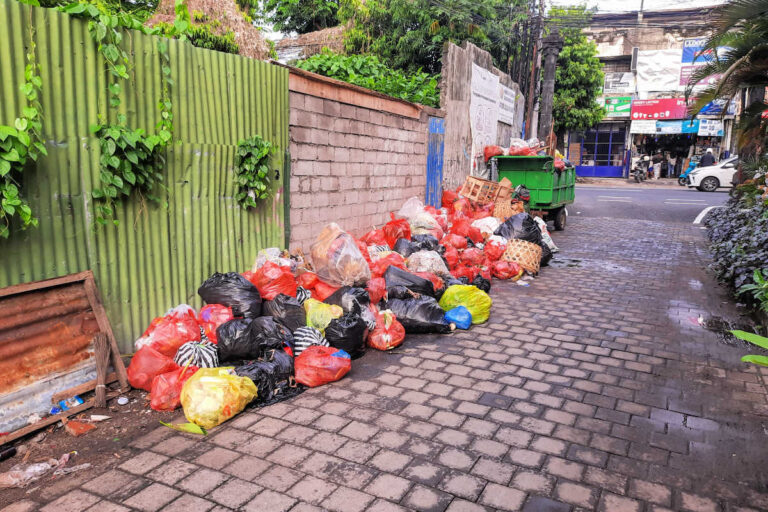
With waste now piling up in communities across the island, and to help tackle the existing issues of waste management, including the dumping of trash in rivers and illegal landfills sites, both local leaders, community activities, private businesses, and NGOs are working to resolve the situation in big and small ways.
Earlier this week, Bali Hotel Association (BHA) and local NGO Sungai Watch installed a new trash barrier along the river in the Banjar Kancil area of Kerobokan, close to Canggu. These river barriers have proven to be a simple but highly effective way to trap tier trash so that it can be removed from the waterways.
Speaking to reporters, BHA’s Head of Sustainability, Ankit Airon, shared, “This is the result of the contributions of all BHA members who have come together to support Sungai Watch and Bali.”
He confirmed that Sungai Watch is responsible for the operation and management of waste retained at the barrier.
Waste will be removed periodically to prevent accumulation at the site. Airon shared, “Usually, around 300 to 350 kilograms of waste are collected every two to three weeks, depending on the amount of waste retained.” Adding “The plastic is reprocessed through the Sungai Design unit into reusable products, such as furniture and other equipment.”
”We work closely with Sungai Watch because they have data and understanding of the amount of waste at each location. From there, we determine the points that need it most.”
Speaking separately, the Speaking Manager of the Sungai Watch Facility in Denpasar, Iqbal Rizali, said the Kerobokan area is one of the areas with the highest volume of waste, making it a strategic location for installing barriers. He shared, “This net was installed about two to three years ago and has proven effective. In one month, it can capture around 400 to 600 kilograms of inorganic waste.
It is not only the Bali Hotel Association (BHA) and Sungai Watch who are working together to help mitigate the trash problem for Bali, but members of the Indonesian Hotel and Restaurant Association (PHRI) Bali, too.
A group of 5-star and 4-star hotels in the Badung Regency area has confirmed that they will be pooling funds to purchase an organic incinerator that will help process organic waste to compost in under six hours. Hotels, restaurants, and cafes contribute to 30-40% of the total waste produced in Denpasar and Badung Regency, and so this will go a long way in helping remove organic waste from the system in the short and long term.
Main Article: Bali Immigration Update
Tourists Breaking The Law
Bali Immigration’s new Dharma Dewata Task Force may have existed for only a couple of weeks, but the team has already successfully caught more than 60 foreign nationals breaking the law.
The Bali Dharma Dewata Task Force is conducting surveillance, patrols, and follow-ups to tips-offs to crack down on foreigners breaking the conditions of their visas and violating Indonesian law.
The Bali Dharma Dewata Immigration Task Force has been out on patrol for just 21 days and has already caught 62 foreign nationals breaking the law. The majority of these 62 individuals have been caught out on immigration laws, though some criminal cases have been found too.
The Head of the Bali Regional Office of the Directorate General (Kakanwil Ditjen) of Immigration, Felucia Sengky Ratna, revealed to reporters that these intensive patrols target vulnerable points within the catchment areas of the Ngurah Rai, Denpasar, and Singaraja Immigration Offices. She explained, “This effort is a form of protection for the tourism industry in Bali Province. This oversight is carried out comprehensively to maintain security stability.”
During a press conference held on 5th May 2026, Ratna explained how the Dharma Dewata Patrols demonstrates Bali Immigration’s commitment to safeguarding the local economy while creating a healthy investment climate and promoting high-quality tourism.
She stated that foreign nationals working illegally must be dealt with firmly to prevent harm to the local workforce.
Ratna explained that the focus of the patrols covers a range of potential violations from all kinda of foreigners in Bali, including tourists, business travellers, investors, and retirees.
Violations officers are looking out for include overstaying or staying beyond the permitted period, using false data to obtain visas, and misusing residence permits for illegal activities. Illegal activities include working without a permit, involvement in fictitious investments, and culturally and socially disruptive and disrespectful behaviour.
Ratna shared that all officers have been instructed to work professionally and considerately while in the field, while taking a zero-tolerance approach, noting “We fully support the Directorate General of Immigration’s policy of enforcing the law against foreign nationals who violate the rules.”
She also called on the public to continue to support the Bali Dharma Dewata Immigration Task Force’s efforts in keeping the province safe. Ratna called on the public, including concerned tourists and international residents, to immediately report any suspicious activity through official complaint channels.
Main Article: Bali Immigration Update

She shared, “Public participation is crucial to maintaining security and public safety in Bali. I order all levels to act decisively and without compromise. We will welcome qualified foreign tourists and investors, but for those who disregard Indonesian law, there are only two choices: comply with our regulations or immediately leave Indonesia.”
The press conference was also attended by Director of Immigration Supervision and Enforcement, Yuldi Yusman, who shared, “We continue to strengthen our oversight and enforcement functions to detect potential violations as early as possible. This enforcement action is clear evidence that the Directorate of Immigration Supervision and Enforcement will not allow foreign nationals who violate the law and disrupt public order.”
Of the more than 7.5 million international tourists who are set to visit Bali this year, the vast majority will only need to encounter Immigration Officers upon arrival and departure, and may be for a visa extension appointment. The most common visa violation detected by Bali Immigration is overstay, followed by breaking the conditions of the visa, e.g., working on a tourist visa, or operating a business on an investment visa.
The Official Indonesia Immigration website is available in English and offers comprehensive support for foreigners seeking to visit, move to, work in, or invest in Indonesia. Foreigners can easily determine which visa is the most appropriate for them by answering the questions on the website through the ‘Apply’ section, which narrows down all available options.
Tourists in Bali are reminded that it is a legal requirement to carry formal ID, ideally a passport, on them at all times in the event of a spot check from the authorities during patrols. In some cases, a different form of ID will be accepted, or a copy of a passport will be permitted, but tourists may be required to produce the passport in person at an immigration office on request.
No responses yet